Every Shipment. Every Route.
Every Cost. Visible in Real Time.
Fleet management, route optimisation, 3PL integration, delivery tracking, driver management, and AI-powered logistics automation — configured specifically for logistics and supply chain businesses across UAE, UK, Australia, and India.
Logistics is a margin business. Every untracked cost, every missed delivery, and every idle vehicle is margin you never recover.
A logistics ERP needs to answer three questions in real time: Where are my vehicles? What does each delivery actually cost? And is my operation running at the utilisation and efficiency it needs to be profitable?
Logistics and supply chain businesses operate on thin margins amplified by volume. The difference between a profitable logistics operation and an unprofitable one is often not the rates charged — it's the operational precision with which deliveries are planned, routes are optimised, vehicles are utilised, and costs are tracked against revenue.
The logistics businesses that run profitably have one thing in common:
Their ERP connects operational data — vehicle position, delivery status, driver hours, fuel consumption — to financial data — cost per delivery, revenue per route, margin per customer — in real time.
Most ERP implementations for logistics companies answer none of these questions.
They configure inventory and accounting and leave the operational heart of the business — fleet, routes, driver management, delivery scheduling — either misconfigured or absent.
Rootlevel configures Odoo so your logistics operation and your finance function speak the same language.
Eight ways a generic Odoo setup fails a logistics business.
Fleet costs tracked in spreadsheets
Vehicle maintenance history, fuel consumption, insurance, registration, and service schedules managed in Excel or paper records — not connected to the ERP. You don't know your true cost per vehicle per month. You don't know which vehicles are costing more than they should.
Delivery scheduling disconnected from inventory
Delivery scheduling done in a separate system — or manually — with no live connection to inventory availability, warehouse readiness, or customer confirmation. Deliveries get scheduled for goods that aren't ready. Customers get missed delivery windows.
Driver management not tracked
Driver hours, trip logs, performance metrics, and licence expiry dates managed informally. No visibility into driver utilisation. No alert when a licence is about to expire. No data to support performance conversations.
3PL costs not allocated to deliveries
Third-party logistics costs — carrier invoices, last-mile delivery charges, cross-docking fees — not allocated to specific delivery orders. Your cost per delivery is incomplete. Customer profitability analysis is impossible.
Customer delivery status communicated manually
Customers call to ask where their delivery is. Someone calls the driver. The driver calls back. Someone calls the customer. This chain happens dozens of times a day. Every call is a cost and every delay in communication is a customer experience failure.
Route planning done by experience not by data
Routes planned by experienced dispatchers using local knowledge — which is valuable but not scalable. When experienced dispatchers are absent, route quality drops. When the business grows, manual route planning becomes a bottleneck.
Proof of delivery not digitised
Delivery confirmation collected on paper — signatures, condition notes, exceptions. Paper PODs get lost, damaged, or delayed in reaching the office. Disputed deliveries have no digital evidence. Invoice disputes take longer to resolve.
Vehicle utilisation invisible
How much of your fleet capacity are you actually using? Which routes are underloaded? Which vehicles are idle on days when others are overloaded? Without utilisation data, fleet investment decisions are guesswork.
Every Odoo logistics capability — configured for operational precision.
Fleet Management
Complete fleet module configuration — every vehicle registered with full specification, insurance details, registration expiry, and service history. Maintenance schedules configured with automatic reminders before service is due. Fuel consumption tracked per vehicle per trip.
Vehicle registration and specs, insurance and registration tracking, service schedule automation, fuel log management, TCO reporting per vehicle, driver assignment tracking.
Delivery Order Management
Delivery orders generated directly from confirmed sales orders — no manual reentry. Delivery scheduling connected to warehouse readiness, vehicle availability, and customer delivery windows. Partial deliveries handled with backorder management.
Sales order to delivery order automation, delivery scheduling, vehicle and driver assignment, partial delivery handling, backorder management, real-time status updates.
Route Planning & Optimisation
Route configuration by zone, area, and delivery frequency. Multi-stop route planning with load optimisation — maximising vehicle utilisation per trip. Route templates for regular delivery runs. Route performance tracking — planned versus actual distance, time, and cost.
Route zone configuration, multi-stop route planning, load optimisation rules, route template management, planned vs actual route reporting.
Driver Management
Driver profiles with licence details, expiry dates, and compliance documentation. Trip assignment and trip log management. Driver performance metrics — on-time delivery rate, fuel efficiency, customer complaints. Licence expiry alerts before the expiry date.
Driver profiles, licence and compliance tracking, trip logs, performance metrics, expiry alert automation.
3PL & Carrier Integration
Third-party logistics costs — carrier invoices, last-mile fees, cross-docking charges — connected to specific delivery orders and allocated correctly to customer cost calculations. FedEx, DHL, and other carrier APIs integrated for automated shipment booking.
FedEx API integration, DHL API integration, carrier invoice allocation to deliveries, 3PL cost reporting, automated shipment booking.
Proof of Delivery — Digital
Digital proof of delivery configured in Odoo — delivery confirmation, customer signature capture, condition notes, and exception recording all done digitally at the point of delivery. PODs immediately available in the system.
Digital POD workflow, signature capture, condition and exception recording, immediate POD availability, dispute management.
Delivery Cost & Profitability Tracking
Every delivery costed — vehicle cost per km, driver cost per hour, fuel, 3PL charges, and overhead allocation — against revenue per delivery order. Customer profitability tracked at delivery level. Route profitability reported by zone and by period.
Cost per delivery calculation, revenue vs cost per delivery, customer profitability by delivery, route profitability reporting.
Supply Chain Visibility
End-to-end supply chain visibility — from purchase order through inbound receipt, warehouse processing, and outbound delivery to customer. Stock in transit, stock at each warehouse location, and stock committed to open delivery orders all visible in real time.
Inbound shipment tracking, warehouse stock by location, committed stock reporting, outbound delivery tracking, supply chain status dashboard.
Where AI and automation create the most value in a logistics operation.
AI Route Optimisation
AI analyses delivery locations, vehicle capacity, traffic patterns, and delivery time windows to suggest optimal route sequences — minimising total distance, maximising vehicle load, and improving on-time delivery rates. Suggested in seconds.
Automated Customer Updates
Automated WhatsApp and email updates to customers at key delivery milestones — order dispatched, out for delivery, delivered, exception raised — triggered by real Odoo delivery status events. Zero manual communication.
Predictive Maintenance Alerts
AI monitors vehicle service schedules, mileage, and maintenance history to predict when preventive maintenance is due — before a breakdown takes a vehicle off the road unexpectedly. Work orders generated automatically.
Automated Delivery Scheduling
When a sales order is confirmed, a delivery order is created and scheduled automatically — based on customer delivery window, warehouse readiness, and available vehicle capacity. No manual scheduling step for standard deliveries.
Carrier Invoice Matching
Carrier invoices matched automatically to delivery orders — amounts verified, discrepancies flagged, approved invoices posted. No manual matching. Carrier billing disputes resolved with delivery data, not memory.
Operations Performance Dashboard
Automated daily logistics performance report — deliveries completed, on-time rate, vehicle utilisation, cost per delivery, customer complaints — delivered to operations managers every morning. Decisions made on today's data.
Odoo for logistics works best for operations where delivery precision and cost visibility directly affect profitability.
Right for you if:
- You operate a fleet of vehicles for delivery, distribution, or freight
- You use third-party carriers and need to track and allocate 3PL costs correctly
- Your delivery scheduling is manual and disconnected from inventory and finance
- You don't have real-time visibility into vehicle location, delivery status, or route performance
- You're based in UAE, UK, Australia, or India and need local compliance built in
- You want AI-powered route optimisation and automated customer communication
- You need cost per delivery tracked accurately to manage customer profitability
Probably not right if:
- You operate purely as a freight broker with no physical fleet
- Your delivery volume is too low to justify ERP-level route and fleet management
- You want logistics modules configured without a proper discovery of your route structures and cost model
Global supply chain operations managed across 5 countries — automated end to end on Odoo 18 Enterprise.
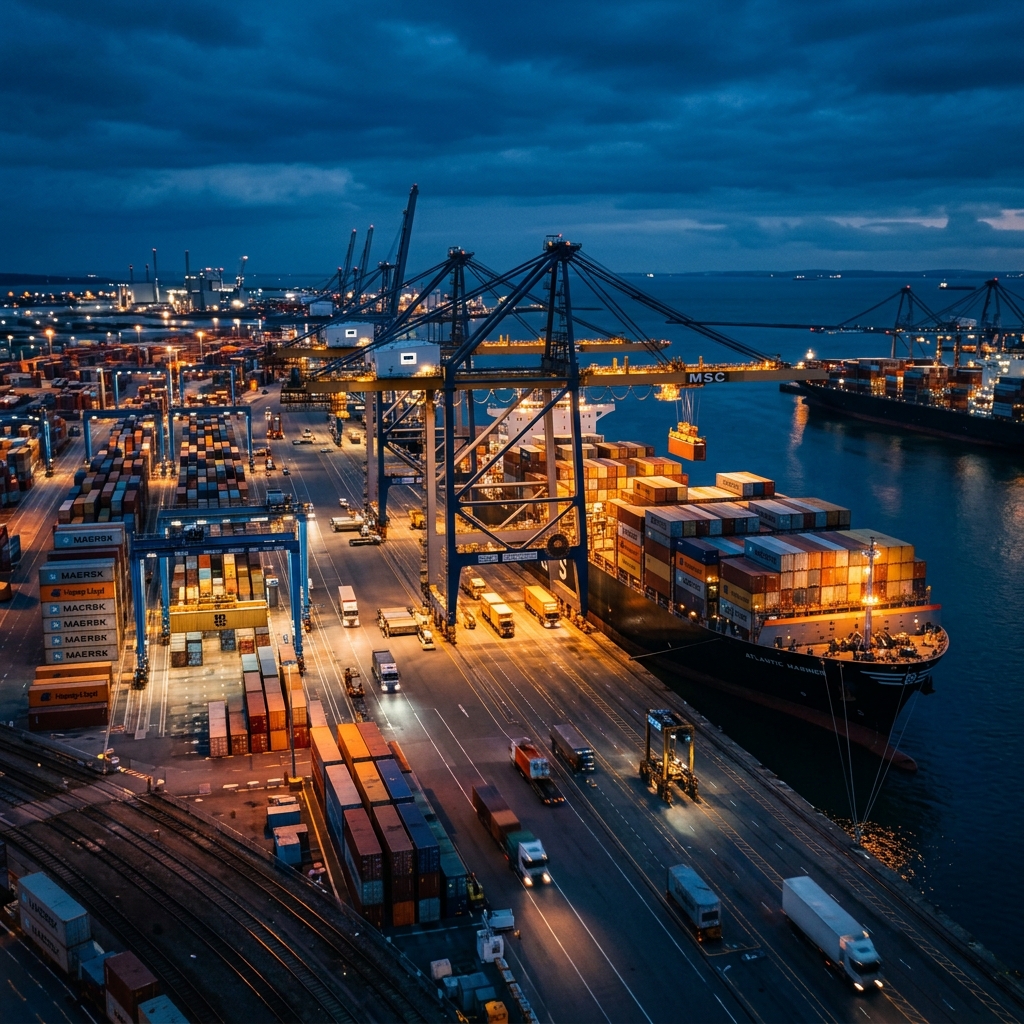
B2B Marketplace & Heavy Machinery — Luxembourg
High-growth marketplace digitising the global supply chain for heavy machinery spare parts — 5 country operations, multi-currency, automated order management
A Luxembourg B2B marketplace managing supply chain operations across UAE, UK, Germany, France, and Netherlands needed Odoo to handle international logistics complexity at scale — multi-country order flows, automated import management, and intelligent product lifecycle management across 20M+ SKUs.
We automated order imports from Magento and eBay across 5 country storefronts, built custom VAT logic for international compliance, and engineered product archive automation to keep operations lean.
Results
- End-to-end order flow automated across 5 countries
- International compliance handled automatically
- Infrastructure costs controlled through intelligent automation
- 70+ tasks delivered under structured management
The tools behind our solutions.
What logistics businesses ask before starting with Odoo.
Running a logistics operation — and your costs, routes, and delivery performance aren't as visible as they should be?
Fleet costs in spreadsheets, manual delivery scheduling, and no real-time visibility into what each delivery costs — all fixable. We've solved all three for logistics businesses across UAE, UK, Australia, and India.