Clothing Manufacturing Without a System: The Daily Problems That Quietly Kill Profit & How to fix it
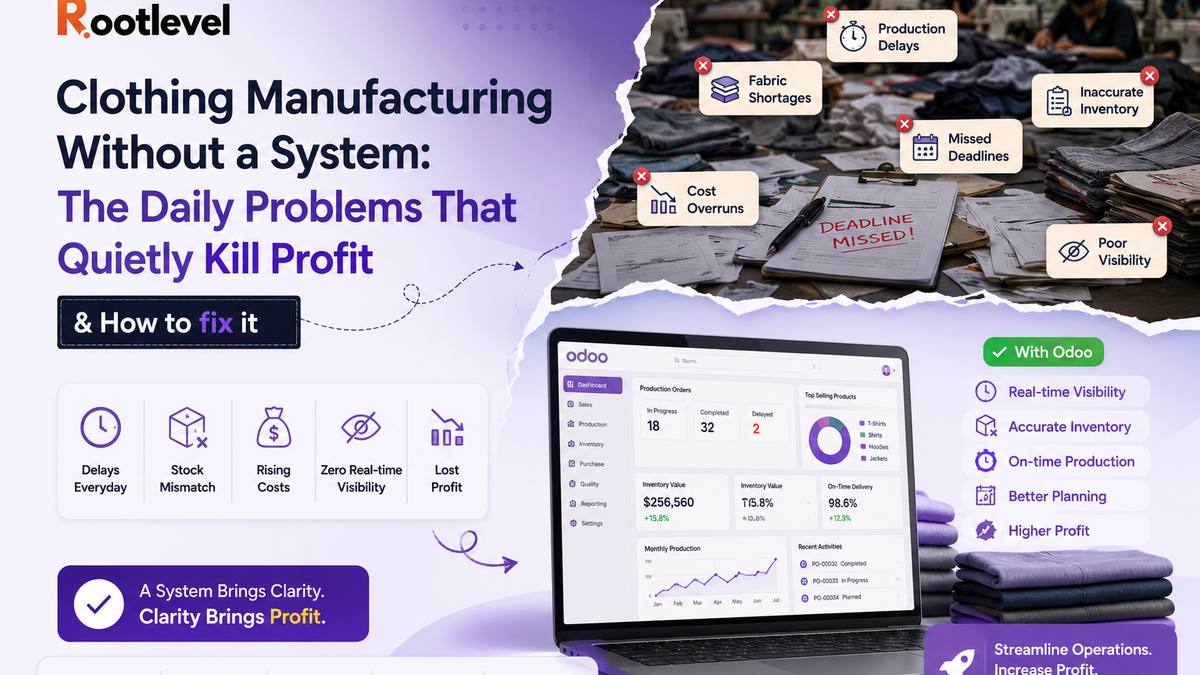
Stop BOM errors, variant confusion, QC leakages, job-work delays, and dispatch bottlenecks with a centralised Odoo ERP—connecting purchase, production, and delivery in one system.
Clothing manufacturing looks fast and exciting from outside—new designs, new collections, constant dispatches.
But inside the unit, profit is decided by daily operations: how you control fabric, manage variants, track job work, prevent rework, and deliver on time.
If your factory still runs on WhatsApp + Excel + “ask the supervisor,” the business can still move—but leaks become normal. And those leaks silently kill margin as you scale.
This blog covers the real daily pains clothing manufacturers face and the practical solutions a connected system like Odoo can bring.
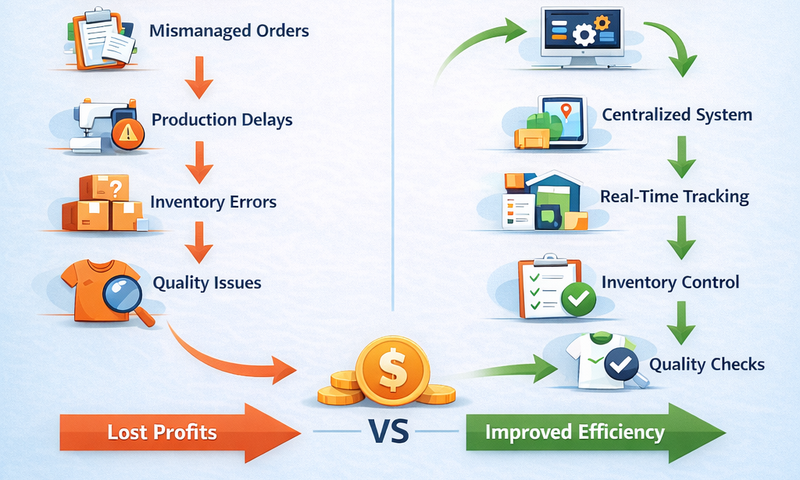
Daily problems clothing manufacturers face
1) BOM & consumption mismatch (fabric, trims, wastage)
- A small mismatch in fabric meters, GSM, lining, buttons, zippers, labels, or thread becomes a huge loss at scale.
- Many teams plan in Excel but actual consumption differs—leading to urgent purchase, wastage, and surprise margin drops.
2) Design-to-production handover confusion
- Design changes don’t always reach production on time: updated size chart, stitching detail, label placement, shade reference, or trim change. Result? Rework, rejected lots, and delayed deliveries.
3) Variant chaos (size/color/fit/style)
- One style becomes 30+ SKUs quickly. If variants aren’t structured properly, the floor produces the wrong SKU, stores/dispatch receives the wrong SKU, and reports become unreliable.
4) No real-time raw material visibility
- Fabric might be available—but reserved for another order, sitting in another godown, or already issued to cutting (not updated anywhere).
- This causes production stoppage and last-minute buying at higher cost.
5) Production planning depends on experience, not data
- Lines get overloaded, some operations stay idle, and priorities change daily.
- Without a clear plan and progress tracking, delays are discovered only when the dispatch date is close.
6) Job work / subcontracting tracking becomes painful
- Dyeing, printing, embroidery, washing, stitching—job work is normal in garments. The issue is tracking: what went out, what came back, what is pending, and what got rejected.
- If this is manual, disputes and shortages become frequent.
7) Quality issues are discovered too late
- If QC happens only at the end, you discover defects after full production—then you pay the cost of rework, discount sale, or returns. Late QC is expensive QC.
8) Dispatch delays due to finishing/packing misalignment
- Production may be ready, but labels/barcodes/cartons/packing lists are not. Or the dispatch team doesn’t know which lots are finalized.
- This creates missed buyer timelines and relationship damage.
9) Costing is unclear (actual vs planned cost per style)
- Many factories don’t know the true cost per SKU after including wastage, job work cost, rework, overhead, and rejection.
- Without accurate costing, high-volume items can quietly become low-margin (or loss-making) products.
If you don’t adapt a system like Odoo, what can you face next?
As more manufacturers modernize operations, staying manual creates long-term risks:
- Margins keep shrinking because wastage + rework + urgent buying becomes a habit.
- Delivery performance drops, and serious buyers shift to vendors who can commit and deliver consistently.
- Dead stock increases (wrong variants, slow-moving colors/sizes, poor planning).
- Business becomes dependent on key people—if the manager/supervisor leaves, operations shake.
- Scaling becomes stressful—new line, new unit, new brand orders all feel like chaos instead of growth.
- Traceability and accountability stay weak—hard to answer “which batch used which fabric lot, which job worker, which QC stage.”
- Decision-making becomes slow because reporting is manual and always “late.”
In short: your factory can still run, but you’ll pay an invisible daily tax in time, money, and missed growth.
Practical solutions with Odoo
1) BOM control with planned vs actual consumption
- Create BOMs for styles and track real consumption vs expected, including wastage.
- This improves purchasing accuracy and protects margin.
2) Centralized product data (styles, variants, components)
- Maintain one clean product master: style → size/color variants → barcodes/SKUs → components.
- This reduces errors across production, inventory, and dispatch.
3) Real-time inventory across godowns and floors
- Track fabric/trims in warehouse, issued quantities, and availability.
- This prevents surprise shortages and reduces last-minute purchases.
4) Production orders and operation tracking
- Plan production orders and track progress through steps like cutting, stitching, finishing, ironing, packing.
- Bottlenecks show up early—not at dispatch time.
5) Job work / subcontracting visibility
- Track materials sent out, expected return dates, received quantities, pending quantities, and rejection—reducing disputes and material leakage.
6) Quality checks at the right stages
- Add QC at cutting/stitching/finishing—not only at the end—so defects are caught early and cost less to fix.
7) Smarter planning using lead times and capacity
- Plan based on material availability, operation time, and delivery commitments.
- This improves on-time delivery and reduces daily priority chaos.
8) Better traceability and accountability
- Know what happened, where it happened, who handled it, and what is pending—so the business is not dependent on “only one person’s knowledge.”
9) Dashboards and reporting without Excel firefighting
- Quick answers: delayed orders, material shortages, job work pending, rejection rates, WIP status, style-wise profitability—without manual reconciliations.
Clothing manufacturing doesn’t lose profit in one big mistake.
It loses profit through daily mismatches: material confusion, variant errors, job-work delays, late QC, and unclear costing.
Next Steps:
If you’re a garment manufacturer, which one hits you the most right now:
Raw material control, job work tracking, or production delays?
Want to see how this would work for your unit? & we’ll walk you through the ideal Odoo setup for your process.